
Raise the Age as a Cost-Effective Alternative to Ever Expanding Adult Corrections
By Joshua Dankoff
Raising the Age of the juvenile court jurisdiction is the most cost-efficient way to ensure that the young people age 18-20 can access developmentally appropriate programming that is managed poorly by the county jails (HOC) and state prisons (DOC).
Both adult and DYS populations have gone down over the last 15 years, yet DYS spending has been flat, and adult spending has gone up almost 25 per cent. The Department of Youth Services (DYS) has the capacity, infrastructure, and already is in custody of 18–20-year-olds including under the Youthful Offender statute.
While there is significant hype and some small young adult units with improved programming and practices in a small number of houses of correction (HOC), these only reach a tiny percentage of the young people; many others are in solitary confirmed (also referred to as “restrictive housing”) spending 22.5 hours a day in isolation. We have within Massachusetts, a DYS system that has achieved better public safety outcomes than the adult system; all at a fraction of the cost of what it would take to get the adult corrections system to bend away from its punishment focus. The annex to this written testimony estimates the first-year caseload impact of the passage of legislation to raise the age of juvenile court jurisdiction to include 18-year-olds, utilizing publicly available data.
Education as evidence based rehabilitative investments.
special education in the adult system is woefully inadequate at every stage, including identification, service delivery, DESE oversight, district involvement, and meaningful academic progress. HOCs and DOC massively fail to identify youth with existing IEPs, as only 8-10% of youth are identified despite evidence that 38- 51% of system-involved youth have disabilities. (51% of youth at DYS have identified disabilities.)
General Education for 18-24 Year Olds in the Adult System Is Inadequate
General education (i.e. K-12) for young adults in the adult correctional system is also deeply insufficient. HOCs invest only 1-5% of their budgets in programming, and DOC invests 1.8%, signaling that education is not a priority. While DYS provides full-time school, HOCs and DOC do not offer consistent, credit-bearing education. Raising the Age as the most cost-efficient and developmentally appropriate way to serve this population.
The Adult Correctional System Cannot Meet the Healthcare Needs of 18-24-Year-Old
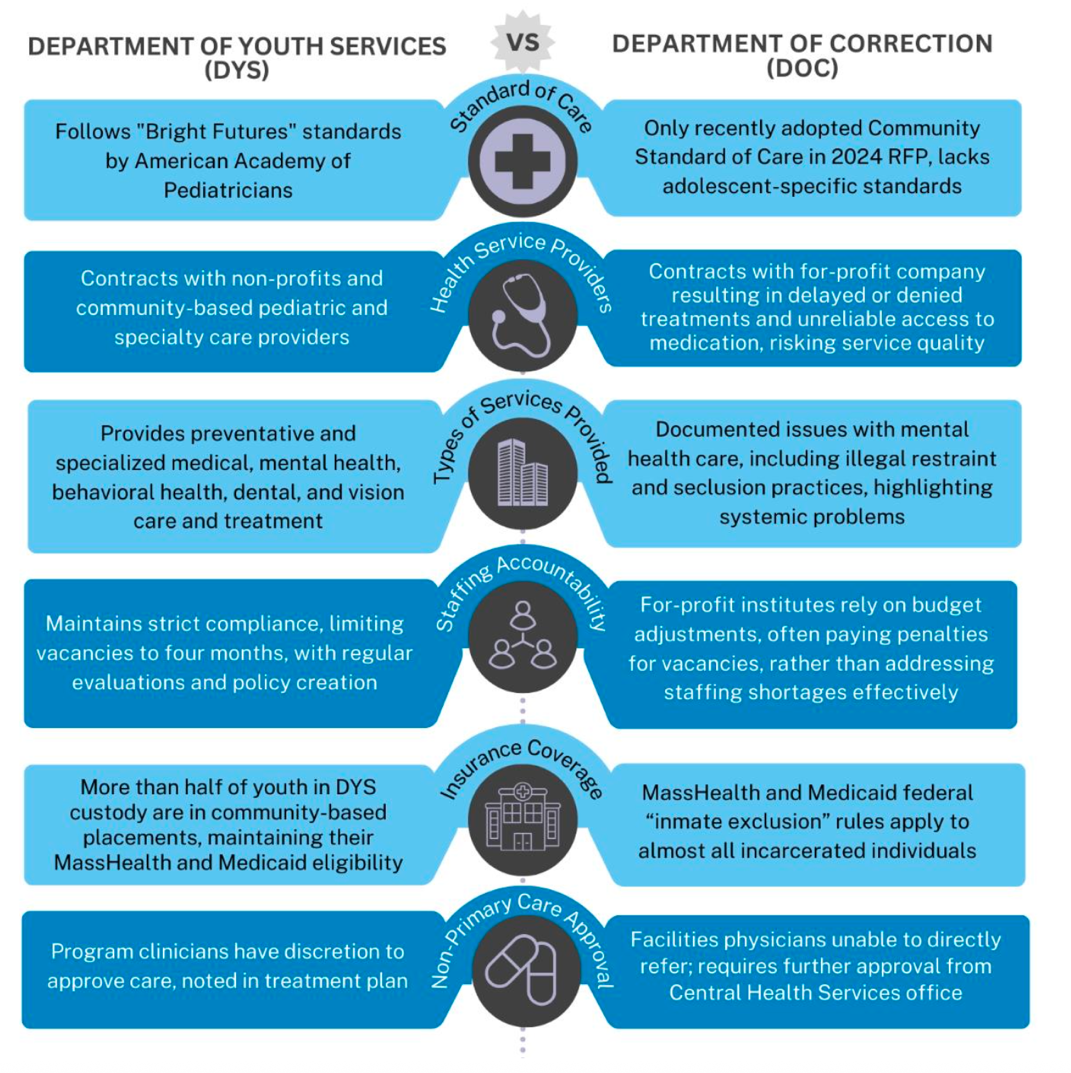
Key differences between DYS and DOC health care
From a healthcare perspective, the adult correctional system is a dangerous, unhealthy place for 18–24-year-olds and the system has broadly demonstrated an inability to provide developmentally appropriate, timely care at or above a community standard. DYS maintains a community standard of health care for youth in its care and custody, contracts with high-quality non-profit pediatric providers, preserves MassHealth eligibility for youth, and delivers a full range of preventative, physical, and mental health services. In contrast, the DOC suspends MassHealth enrollment, relies on for-profit medical contractors with documented histories of delayed or denied treatment, and routinely fails to meet even basic clinical standards, such as timely sick-call responses, adequate mental health services, and clear documentation of care.
Overreliance on Facility-Based Custody When Community-Level Supervision Is More Cost-Efficient and Less Harmful
The most cost-efficient way to manage young adults is not through extended carceral custody in HOCs or DOC, but by transitioning individuals safely back into the community settings, using he least restrictive method appropriate. At times, GPS monitoring may be deemed appropriate, and the DOC and about half of the HOCs already operate GPS monitoring ankle bracelet programs, at significantly reduced cost than incarceration. However, as the CfJJ’s E-Carceration report shows, when GPS is applied too broadly, for too long, and without adequate oversight, this can result in frequent technical violations, restricted access to work, school, and healthcare, and conditions that can resemble “virtual incarceration.” These harms are magnified for young adults, who are developmentally less able to navigate rigid compliance requirements and more vulnerable to the cascading consequences of technical violations. There remain opportunities to update the classification systems to decarcerate and move people into less restrictive (and less expensive) settings, including an expansion of the community-based placements (using GPS monitoring only as necessary).
Too Much Collaboration: DOC and HOC Relationships with ICE.
One area where there is too much collaboration is between DOC, most of the HOCs and the federal immigration infrastructure. Sheriff departments regularly share daily intake logs with ICE of people coming into custody. This goes well beyond information that is publicly available and includes information that is not required by law. The current legal framework that allows collaboration/information sharing with ICE undermine core principals of the juvenile and criminal legal systems, namely that there is a presumption of innocence, due process with an opportunity to defend oneself against allegations and a right to an attorney, among other things. While the immigration system is apparently ‘civil’ in nature, the Trump Administration has criminalized and militarized the immigration system such that the real-world consequences for a ‘civil’ immigration violation are more akin to criminal punishment: arrest, detention often far away from family and community supports, little to no access to legal counsel and the possibility of deportation.
Read CfJJ’s complete testimony to the Massachusetts Joint Committee on Race Equity, Civil Rights and Inclusion.